
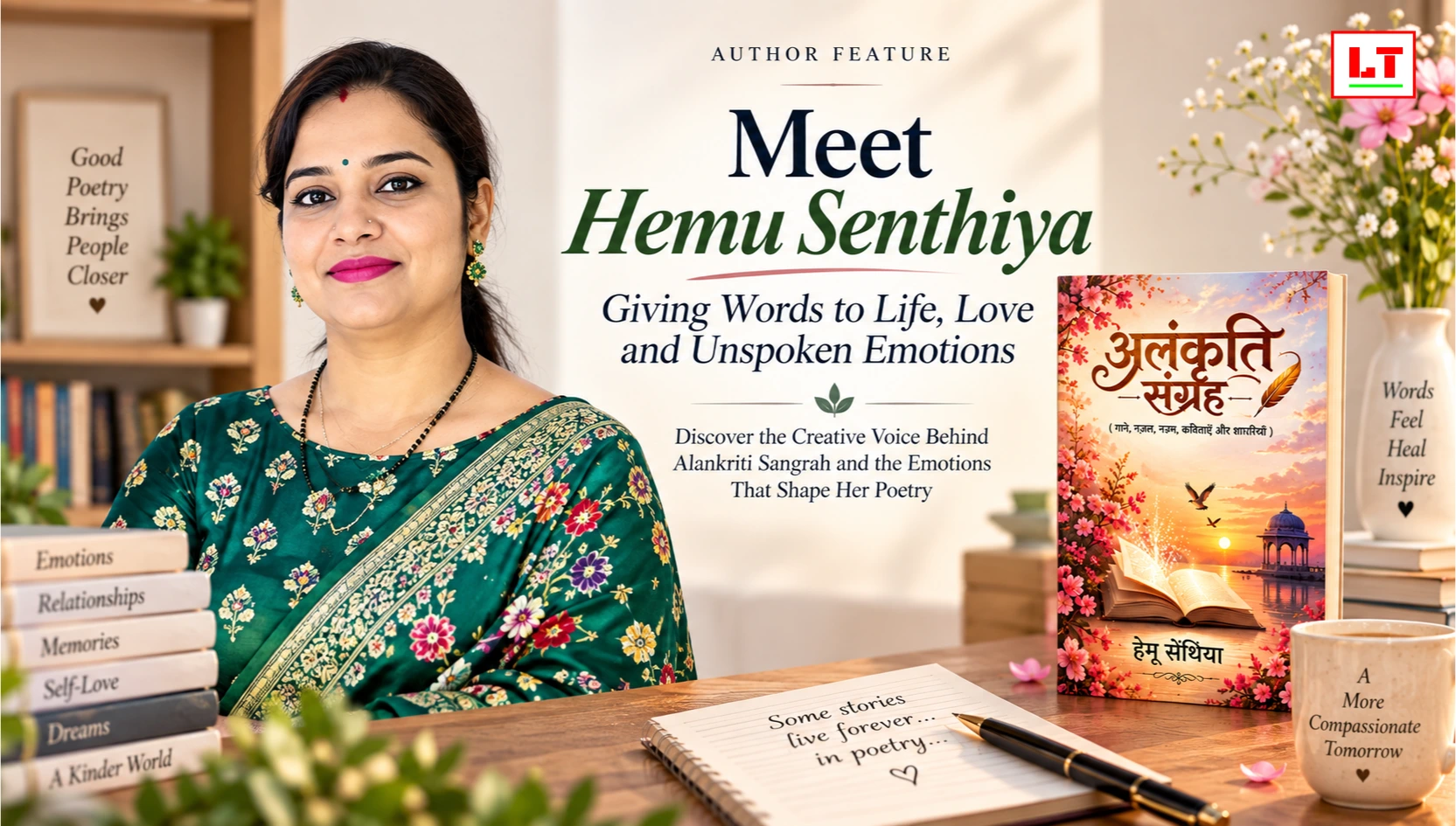
Discover the Creative Voice Behind Alankriti Sangrah and the Emotions That Shape Her Poetry
Some writers create imaginary worlds. Others look closely at the world already around us and discover stories, emotions and meanings hidden inside ordinary moments. Hemu Senthiya (हेमू सेंथिया) belongs to the latter space through her Hindi poetry collection अलंकृति संग्रह (Alankriti Sangrah).
Through “गाने, ग़ज़ल, नज़म, कविताएँ और शायरियाँ”, the collection explores an emotional landscape filled with love, relationships, memories, family, self-reflection, dreams, nature and social consciousness. What makes this creative landscape interesting is its familiarity. The subjects are not distant from everyday life. A memory, a relationship without a name, the fragrance of soil, mehndi, a daughter, a dream or even a moment of self-reflection can become the starting point for poetic expression.
Through Alankriti Sangrah, Hemu Senthiya invites readers to rediscover such emotions through words.
Meet Hemu Senthiya
Hemu Senthiya is the author of Alankriti Sangrah, a Hindi literary collection that brings several forms of creative expression together within one book. The themes represented in her collection reveal an interest in the many dimensions of human experience. There is love, but also self-love. There are relationships, but also relationships that cannot easily be defined. There are memories of what has passed and dreams of what may still come. There are familiar cultural and family emotions alongside thoughts extending towards society and civic consciousness. This thematic variety gives readers multiple ways to enter her poetic world.
When Everyday Feelings Become Poetry
Not every meaningful moment announces itself as important. Sometimes it is only later that we realise how deeply an ordinary conversation, a familiar place, a particular fragrance or a brief meeting affected us. Poetry has the ability to preserve these moments.
A writer can take something that appears small and allow the reader to see the emotion hidden inside it. Several themes in Alankriti Sangrah reflect this connection between everyday experience and emotional expression. Mitti Ki Khushboo (मिट्टी की खुशबू) can evoke roots and belonging. Yaadon Ka Shehar (यादों का शहर) brings memory and place together. Mehndi (मेंहदी) can carry associations with tradition, celebration and relationships. Chiraiya (चिरैया) can open the imagination towards freedom, tenderness or home. The subjects may be familiar, but poetry gives them another dimension.
A Creative Voice Rooted in Emotion
At the centre of Alankriti Sangrah is emotion. That does not mean every piece has the same mood. Quite the opposite. The collection moves through different emotional territories, allowing affection, nostalgia, reflection, hope, relationships and social awareness to exist alongside one another.
This is important because human emotions rarely exist in isolation. Love can carry memory. Memory can contain both happiness and sadness. A relationship can bring affection as well as uncertainty. A dream can carry hope alongside fear. By moving across different subjects, the collection reflects something familiar about life itself: our emotions overlap.
Love Beyond the Usual Love Story
Love has inspired poetry for centuries, yet there is no single way to write about it. Some love stories are complete. Some remain unfinished. Some relationships have names. Others resist definition. Themes such as Ek Tarfa Mulakaat (एक तरफा मुलाकात) and Benaam Rishta (बेनाम रिश्ता) draw attention towards these less straightforward emotional spaces. A meeting may last only a short time but remain in memory for years.
A relationship may never acquire a conventional label but still influence someone’s life. These are experiences that can be difficult to explain in ordinary conversation. Poetry allows them to exist without demanding a simple conclusion. Sometimes the absence of an answer is itself part of the emotion.
The Emotional World of Memories
Memory is one of literature’s most powerful subjects because it belongs to everyone. People remember differently, but almost everyone understands what it means to be unexpectedly transported into the past.
A song can do it. So can a fragrance. A photograph. A street. A season. Or the mention of a familiar name. Yaadon Ka Shehar captures this relationship between memory and place particularly well as an idea. The places we remember are rarely made only of buildings and roads. They are made of people, experiences, conversations and emotions. Similarly, Mitti Ki Khushboo can immediately suggest familiarity and roots. Such themes show how poetry can transform ordinary sensory experiences into emotional reflections.
Family, Affection and Familiar Indian Experiences
Some of the themes within Alankriti Sangrah also draw upon experiences that can feel particularly familiar within an Indian cultural setting. Consider titles such as Laado (लाडो) and Mehndi (मेंहदी). The word Laado itself can carry warmth, affection and familial tenderness.
Mehndi can evoke celebrations, traditions, relationships and memories surrounding important occasions. These familiar references can create an immediate emotional connection because readers bring their own experiences to the words. A poet provides the image. The reader often supplies the memory. That interaction between writer and reader is part of what makes poetry personal.
Swayam Se Prem: Looking Within
Among relationships with family, loved ones and society, there is another relationship that deserves attention: the relationship with oneself. Swayam Se Prem (स्वयं से प्रेम) introduces this inward-looking dimension. Self-love can mean different things to different people, but at its simplest it begins with self-understanding.
It can mean recognising one’s emotions. Accepting imperfections. Allowing oneself to grow. And understanding that personal worth does not always have to depend upon external validation. Including such a theme expands the emotional vocabulary of the collection beyond conventional ideas of romantic love. It reminds readers that sometimes the most important conversation is the one happening quietly within.
Giving Dreams Their Own Language
If memories take us backward, dreams move us forward. Sapno Ki Udaan (सपनों की उड़ान) and Pyara Sa Swapn (प्यारा सा स्वप्न) bring aspiration and imagination into the collection. Dreams are deeply individual, yet the desire to imagine a better tomorrow is universal. For one person, a dream might be professional success.
For another, creative fulfilment. For someone else, it might mean love, peace, freedom or simply the opportunity to begin again. Poetry gives such aspirations an emotional language. It allows a dream to become more than a goal. It can become an image, a feeling and a possibility.
From Personal Emotion to Social Awareness
The thematic world represented in Alankriti Sangrah does not remain entirely private. Nagrik Bhavna (नागरिक भावना) introduces a social dimension to the collection. Its presence suggests a movement from personal feelings towards our relationship with the wider community. This broader perspective is significant because poetry has historically engaged with both private and collective experience. A writer can reflect on love and still think about society.
A poem can celebrate personal freedom while also considering responsibility. Literature can look inward and outward at the same time. This range gives Alankriti Sangrah a broader thematic canvas than a collection centred only on romantic expression.
The World Inside Alankriti Sangrah
The subtitle of the book describes its literary range as:
“गाने, ग़ज़ल, नज़म, कविताएँ और शायरियाँ”
That variety is important.
Different forms of creative writing can carry different rhythms, moods and emotional textures. Rather than asking the reader to remain within one particular type of poetry, Alankriti Sangrah brings multiple forms of expression together. Its themes include:
- Love and relationships
- Memories and nostalgia
- Family and affection
- Self-love and introspection
- Dreams and aspirations
- Nature and familiar surroundings
- Cultural experiences
- Civic and social consciousness
The result is a collection designed for different moods and different moments.
What Readers Can Discover in Hemu Senthiya’s Poetry
One of the interesting things about poetry is that the writer and reader do not necessarily experience the same poem in exactly the same way. The writer begins with an emotion. The reader arrives with a lifetime of personal experiences. Somewhere between those two, meaning is created. A reader who has recently revisited an old place may connect strongly with Yaadon Ka Shehar. Someone thinking about an undefined relationship may be drawn towards Benaam Rishta. A reader going through a period of personal growth may find Swayam Se Prem more meaningful. Someone pursuing a long-held ambition may connect with Sapno Ki Udaan. The collection therefore does not need every reader to respond to every piece in the same way. Its variety allows readers to discover their own emotional connection.
The Beauty of Writing About Ordinary Life
There is a misconception that literature needs extraordinary events to be meaningful. Often, the opposite is true. The experiences readers recognise most strongly may be very ordinary:
Watching rain.
Remembering home.
Missing someone.
Seeing a bird fly.
Thinking about a daughter.
Applying mehndi.
Revisiting an old memory.
Dreaming about tomorrow.
These experiences are familiar precisely because they belong to everyday life. A writer’s role can be to look at them differently—to notice the emotion that routine sometimes hides. That is one of the spaces in which the themes of Alankriti Sangrah operate.
Why Poetry Can Create a Personal Connection
Unlike many longer narrative forms, poetry does not always tell the reader exactly what to think. It leaves space. Space for interpretation. Space for memory. Space for imagination. And sometimes, space for silence. That can make the reading experience intensely personal. Two people may read the same lines and remember completely different moments from their own lives. One may feel hope. Another may feel nostalgia. A third may simply find comfort in discovering that someone else has attempted to put a familiar emotion into words. This is why poetry can remain with readers long after the page has been turned.
Alankriti Sangrah at a Glance
Book: Alankriti Sangrah (अलंकृति संग्रह)
Author: Hemu Senthiya (हेमू सेंथिया)
Language: Hindi
Category: Poetry & Shayari
Includes: Songs, Ghazals, Nazm, Poems & Shayari
Themes: Love, Relationships, Memories, Family, Self-Love, Dreams, Nature & Society
Who May Enjoy Alankriti Sangrah?
The collection may particularly appeal to readers who enjoy Hindi poetry rooted in emotions and everyday experiences. It may be worth exploring if you enjoy:
- Hindi poetry and shayari
- Ghazals and nazm
- Writing about love and relationships
- Poetry about memories and nostalgia
- Family-oriented emotional writing
- Self-reflection and personal growth
- Dreams and aspirational themes
- Literature inspired by everyday life
It may also suit readers who prefer books they can return to gradually rather than reading continuously from beginning to end. A poem today. Another next week. A familiar line months later. Poetry often becomes part of a reader’s life in this way.
Hemu Senthiya and the Power of Unspoken Emotions
Perhaps one of the most interesting spaces for a poet exists between what people feel and what they are able to say. We do not always tell someone how much they matter. We do not always explain why an old memory still affects us. We may not know how to describe our relationship with our roots, dreams or even ourselves. Yet these emotions remain. Writing gives them somewhere to go. Through the themes brought together in Alankriti Sangrah, Hemu Senthiya explores this space between emotion and expression. The result is a collection that invites readers to do more than simply read. It invites them to remember. Reflect. Imagine. And, most importantly, feel.
Discover Alankriti Sangrah
If you enjoy Hindi poetry, ghazals, nazm and shayari exploring love, memories, relationships, dreams and everyday life, discover Alankriti Sangrah by Hemu Senthiya.
Explore Alankriti Sangrah on Amazon
Frequently Asked Questions
Who is Hemu Senthiya?
Hemu Senthiya is the author of the Hindi literary collection Alankriti Sangrah (अलंकृति संग्रह), which brings together songs, ghazals, nazm, poems and shayari.
What is Alankriti Sangrah about?
The collection explores different aspects of human experience, including love, relationships, memories, family, self-reflection, dreams, nature and civic consciousness.
What type of writing does Hemu Senthiya include in Alankriti Sangrah?
The book describes its literary forms as “गाने, ग़ज़ल, नज़म, कविताएँ और शायरियाँ.”
Is Hemu Senthiya’s book only about love and relationships?
No. Love and relationships are important themes, but the collection also explores memories, family, self-love, dreams, nature and social consciousness.
Which themes appear in Alankriti Sangrah?
Themes represented in the collection include Mitti Ki Khushboo, Laado, Yaadon Ka Shehar, Swayam Se Prem, Mehndi, Chiraiya, Ek Tarfa Mulakaat, Nagrik Bhavna, Benaam Rishta, Sapno Ki Udaan, Makhmali Chand Diary and Pyara Sa Swapn.
Who may enjoy reading Alankriti Sangrah?
Readers interested in Hindi poetry, shayari, ghazals, nazm and emotionally expressive writing about relationships and everyday life may find the collection appealing.
Where can I find Alankriti Sangrah?
Readers can explore the book through its Amazon listing. View Alankriti Sangrah on Amazon
Inspiring Authors.
Fresh Perspectives.
Discover remarkable books, inspiring author stories, exclusive literary insights and fresh ideas delivered directly to your inbox.
