
Modern life presents an interesting contradiction.
We have unprecedented access to technology, information, comfort, and communication. Yet many people continue searching for answers to questions humanity has asked for centuries:
Why am I dissatisfied despite achievement?
How can I manage my mind?
What creates lasting happiness?
How should I respond when circumstances are beyond my control?
Can ambition coexist with inner peace?
These questions sit at the intersection of modern psychology, personal development, philosophy, and spirituality.
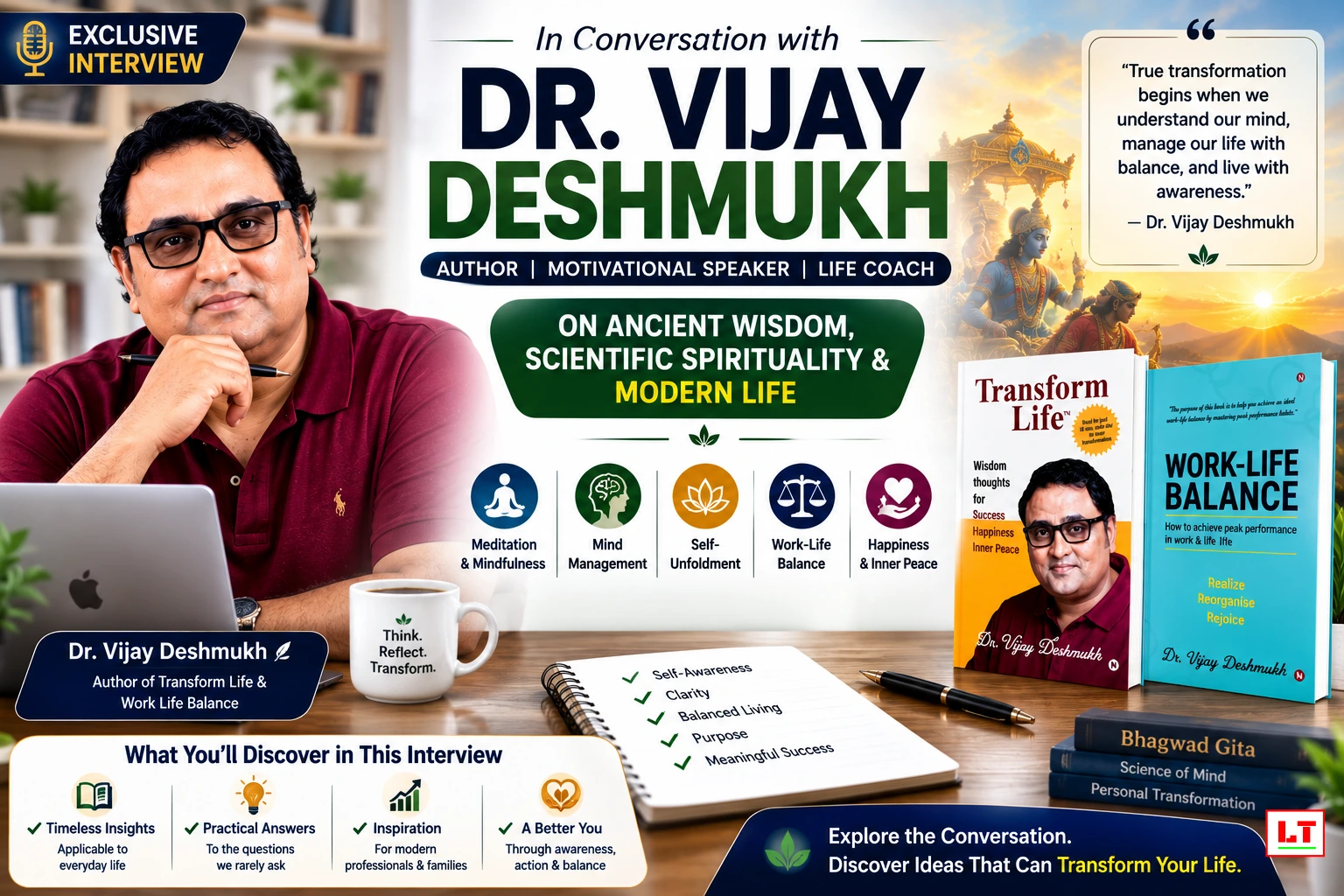
They also form an important part of the work of Dr. Vijay Deshmukh, author, motivational speaker, life coach, and implantologist based in Pune.
His first English self-help book, Transform Life: Wisdom Thoughts for Success Happiness Inner Peace, published in 2017, explores self-unfoldment through simplified wisdom. Its thought flow has been described as greatly aligned with the teachings of the Shrimad Bhagwad Gita, while the book also connects ancient wisdom with modern scientific knowledge.
His second book, Work Life Balance: How to Achieve Peak Performance in Work and Life, takes the discussion into the practical world of careers, relationships, stress, time management, and peak performance.
In this October interview, Dr. Deshmukh discusses the relationship between scientific spirituality and everyday life.
Q1. You frequently use the term “scientific spirituality.” What does it mean to you?
Answer by Dr. Vijay Deshmukh:
Scientific spirituality means approaching spiritual ideas with observation, understanding, and practical experience rather than accepting concepts only because they have been repeated traditionally. Human beings have an inner world of thoughts, emotions, desires, fears, and reactions. We can observe this world carefully, just as we observe external phenomena. When spiritual principles help us understand these inner processes and produce meaningful changes in behaviour, relationships, and peace of mind, they become practically relevant to modern living.
Q2. Why do ancient teachings remain relevant in a technology-driven world?
Answer by Dr. Vijay Deshmukh:
Technology has changed our environment tremendously, but many fundamental aspects of the human mind remain familiar. People still experience fear, attachment, anger, ambition, comparison, uncertainty, happiness, and disappointment. Ancient wisdom examined these questions deeply. The challenge is not to copy the lifestyle of another era but to understand the underlying principles and apply them intelligently today. Timeless wisdom becomes valuable when it helps a modern person handle a modern problem with greater clarity.
Q3. Your book has been associated with the thought flow of the Shrimad Bhagwad Gita. What can modern professionals learn from it?
Answer by Dr. Vijay Deshmukh:
One important lesson is learning to focus sincerely on action without allowing complete emotional dependence on the outcome. Professionals naturally need goals and results, but anxiety increases when our peace becomes entirely dependent on receiving a specific result. We should prepare well, act responsibly, learn continuously, and give our best effort. At the same time, we need the inner maturity to accept that every outcome is influenced by factors beyond our personal control.
Q4. Does spirituality conflict with ambition or material success?
Answer by Dr. Vijay Deshmukh:
I do not see a necessary conflict. Ambition can be constructive when it encourages growth, excellence, contribution, and learning. The difficulty arises when achievement becomes the sole source of identity or happiness. Spiritual understanding can help a person pursue success with greater awareness and balance. You can build a career, create wealth, lead an organization, and pursue ambitious goals while still developing contentment, compassion, relationships, and inner peace.
Q5. Why is meditation so central to your approach?
Answer by Dr. Vijay Deshmukh:
Meditation gives us an opportunity to observe the mind directly. During ordinary life we are continuously engaged with external events and often react automatically. Meditation creates a quieter space where thoughts and emotions can be noticed more clearly. With practice, this awareness can influence everyday behaviour. The objective is not simply to feel peaceful during meditation; it is to carry greater awareness into decisions, conversations, stressful situations, and relationships.
Q6. Can positive thinking become unrealistic?
Answer by Dr. Vijay Deshmukh:
Yes, if positive thinking is misunderstood as denying reality. Genuine positivity does not mean pretending that difficulties do not exist. It means recognizing the difficulty while maintaining confidence in our capacity to respond constructively. If a project fails, positive thinking should not say that nothing went wrong. It should help us analyze what happened, learn from it, and decide the next action without becoming mentally defeated.
Q7. What is the relationship between visualization and action?
Answer by Dr. Vijay Deshmukh:
Visualization can help create clarity about a desired state or outcome. An athlete may visualize performance, a professional may visualize delivering confidently, and an individual may imagine responding calmly in a difficult situation. But visualization without action remains incomplete. Its real value comes when the mental picture influences preparation, habits, and behaviour. The mind receives direction, and disciplined action then moves the individual toward the goal.
Q8. Why do people sometimes continue repeating behaviours they know are harmful?
Answer by Dr. Vijay Deshmukh:
Knowledge alone does not automatically change deeply established patterns. A person may understand intellectually that anger damages relationships or that excessive stress is harmful, but habitual reactions can still continue. Repeated awareness, contemplation, practice, and self-observation are necessary. This is why I value reading and rereading meaningful thoughts. With repetition, understanding can gradually move deeper and begin influencing subconscious patterns and everyday behaviour.
Q9. How can someone bring spirituality into ordinary professional life without becoming detached from practical responsibilities?
Answer by Dr. Vijay Deshmukh:
Spirituality should improve the way responsibilities are handled, not become an excuse to avoid them. It can appear in professional life through integrity, emotional control, respectful communication, clarity, discipline, and the ability to remain balanced during success and failure. A spiritually aware professional should ideally become more responsible and effective because greater self-understanding improves the quality of action.
Q10. What does inner transformation ultimately look like in everyday life?
Answer by Dr. Vijay Deshmukh:
Transformation is visible in our responses. Perhaps a situation that previously created intense anger is now handled calmly. A failure that once produced despair becomes a learning experience. Success is enjoyed without arrogance. Relationships receive greater attention. Decisions become more thoughtful. Inner transformation may not always look dramatic from the outside, but gradually the quality of thinking, behaviour, relationships, and experience changes. That is where wisdom becomes practical.
📚 Explore the Books
Transform Life: Wisdom Thoughts for Success Happiness Inner Peace
Work Life Balance: How to Achieve Peak Performance in Work and Life
Buy Work Life Balance on Amazon
Inspiring Authors.
Fresh Perspectives.
Discover remarkable books, inspiring author stories, exclusive literary insights and fresh ideas delivered directly to your inbox.
