
We spend enormous amounts of time learning how to achieve.
How to build careers.
How to earn more.
How to become productive.
How to compete.
How to lead.
But there is another category of questions that receives far less attention:
What happens after achievement?
Why do some successful people remain dissatisfied?
How do we know whether our goals genuinely belong to us?
Can ambition and inner peace coexist?
How can difficult experiences contribute to transformation?
And what does it really mean to “unfold” oneself?
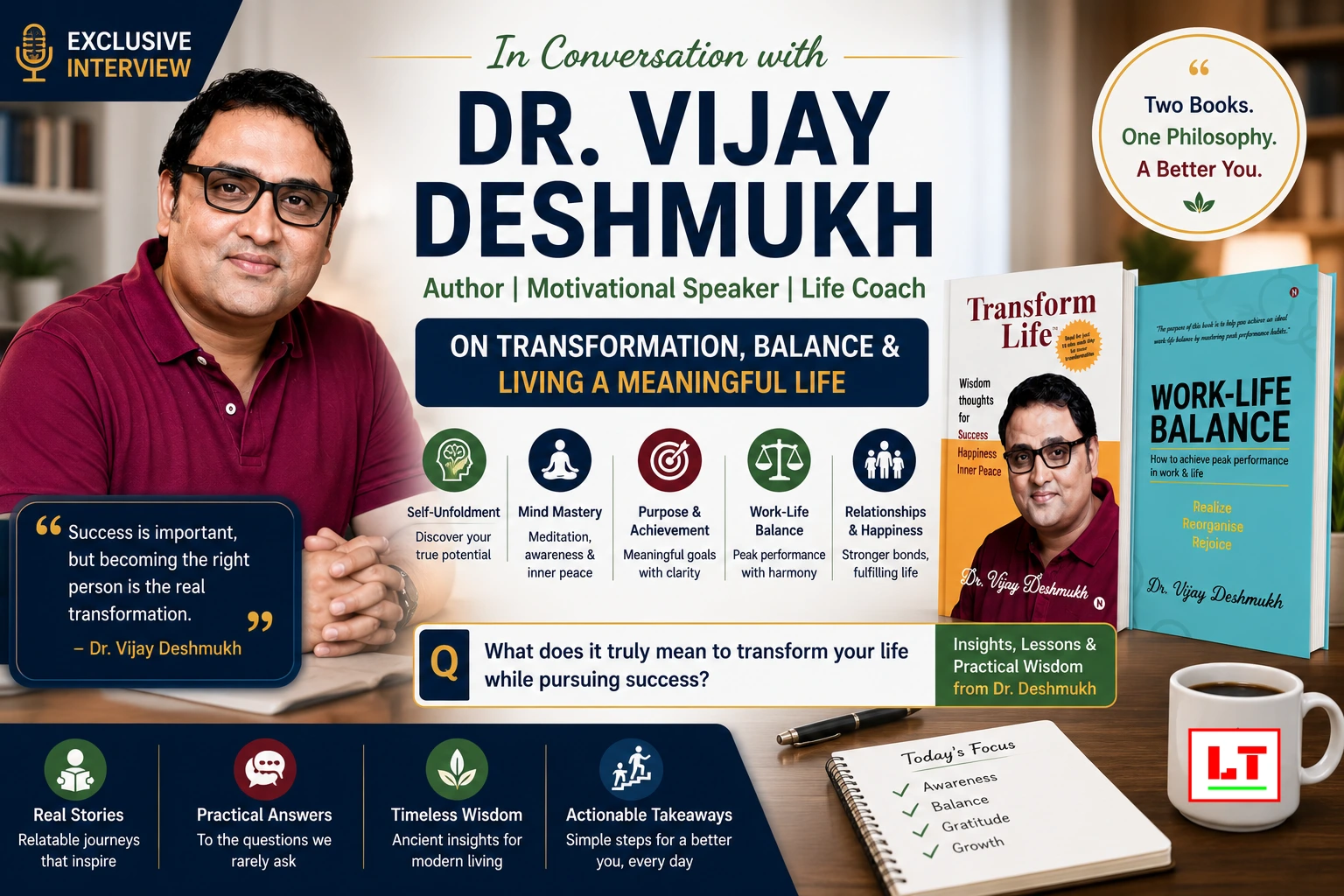
These themes sit at the intersection of Dr. Vijay Deshmukh‘s two books: Transform Life: Wisdom Thoughts for Success Happiness Inner Peace and Work Life Balance: How to Achieve Peak Performance in Work and Life.
Dr. Deshmukh is an author, motivational speaker, life coach, and implantologist based in Pune. His decades of clinical practice and interaction with thousands of people, combined with meditation and an interest in scientific spirituality, have strongly influenced his observations about human behaviour.
Q1. Your first book uses the idea of “self-unfoldment.” What does self-unfoldment mean to you?
Answer by Dr. Vijay Deshmukh:
Self-unfoldment is not about becoming somebody completely different. It is about gradually discovering and expressing the potential that already exists within you. Many people live according to external expectations without deeply understanding their own mind, strengths, values, and purpose. Through observation, contemplation, meditation, learning, and experience, greater clarity can emerge. Transformation then becomes less about creating a new identity and more about removing the limitations that prevent our better qualities from expressing themselves.
Q2. Why can achievement sometimes fail to produce fulfilment?
Answer by Dr. Vijay Deshmukh:
Achievement is valuable, but we often expect it to perform a function it cannot always perform. A promotion can improve professional standing, but it cannot automatically create inner peace. Money can provide comfort and opportunities, but it cannot guarantee meaningful relationships or emotional stability. Fulfilment comes when external progress is accompanied by internal understanding. When people learn to appreciate achievement without making their entire happiness dependent on it, success becomes much healthier and more enjoyable.
Q3. How can someone distinguish healthy ambition from unhealthy ambition?
Answer by Dr. Vijay Deshmukh:
Healthy ambition encourages growth while respecting the other important dimensions of life. Unhealthy ambition gradually consumes them. If your goals consistently require you to neglect health, relationships, values, or peace of mind, it is worth examining the direction carefully. Ambition should energize you more often than it empties you. There will naturally be demanding periods, but they should not become a permanent lifestyle. Achievement should expand life rather than continuously make life smaller.
Q4. What role do setbacks play in personal transformation?
Answer by Dr. Vijay Deshmukh:
Setbacks can become powerful teachers because they interrupt our assumptions. Success often confirms what we already believe, while difficulty forces us to examine ourselves more deeply. A setback may reveal impatience, attachment, fear, unrealistic expectations, or a weakness that needs improvement. The experience itself does not automatically create wisdom; reflection creates wisdom. When we ask what a difficult situation is teaching us instead of only asking why it happened, adversity can contribute significantly to personal growth.
Q5. Many people understand what they should change but still cannot change their habits. Why?
Answer by Dr. Vijay Deshmukh:
Intellectual understanding and internal transformation are different things. We may know that anger is harmful, that exercise is important, or that worrying excessively is unproductive, yet continue repeating the same behaviour. Habits are deeply connected with subconscious patterns and repeated responses. This is why reflection, repetition, awareness, and disciplined practice are important. A useful thought needs to move from information to understanding and then from understanding into everyday behaviour before genuine transformation occurs.
Q6. How can meditation help a highly ambitious professional?
Answer by Dr. Vijay Deshmukh:
An ambitious professional uses the mind continuously—for planning, analyzing, deciding, communicating, and solving problems. Meditation provides an opportunity to observe and settle that same mind. It can improve awareness of thoughts and emotional reactions and create greater clarity before action. Meditation should not be viewed as withdrawing from ambition. Properly understood, it can support better performance because a calmer mind can often focus and decide more effectively than a continuously agitated one.
Q7. Do people sometimes confuse being busy with being successful?
Answer by Dr. Vijay Deshmukh:
Very often. Busyness is visible, so it can create the impression of productivity. But the number of hours occupied does not automatically represent the value created. A person may spend an entire day reacting to messages and minor tasks while avoiding the one activity that truly matters. Peak performance requires prioritization and focused energy. Professionals should periodically ask whether their activities are moving them toward meaningful objectives or simply keeping them continuously occupied.
Q8. How important is contentment if someone still wants to achieve more?
Answer by Dr. Vijay Deshmukh:
Contentment and ambition are not contradictory. Contentment means appreciating what exists today while continuing to work toward tomorrow. Without contentment, every achievement immediately becomes insufficient because the mind moves to the next desire. Without ambition, growth may stop. The ideal approach is to combine gratitude for the present with constructive effort toward the future. This allows a person to progress without making happiness permanently dependent on the next milestone.
Q9. What should a person do when life feels directionless despite being professionally successful?
Answer by Dr. Vijay Deshmukh:
Such moments are invitations for deeper reflection. Instead of immediately setting another professional target, ask what areas of life have been neglected. Examine relationships, health, personal interests, learning, contribution, and inner development. Sometimes directionlessness occurs because one dimension of life has received all our attention while the others have remained undeveloped. Creating a broader definition of purpose can restore meaning without necessarily abandoning professional success.
Q10. If readers could adopt only one principle from your two books, what would you want it to be?
Answer by Dr. Vijay Deshmukh:
I would encourage readers to develop greater awareness of themselves and the way they are living. Awareness allows us to recognize when thoughts are becoming unhealthy, when ambition is creating imbalance, when relationships need attention, and when our definition of success needs reconsideration. Once awareness develops, better choices become possible. Both inner transformation and work-life balance ultimately begin with understanding ourselves more clearly and living with greater consciousness.
📚 Explore the Books
Transform Life: Wisdom Thoughts for Success Happiness Inner Peace
Work Life Balance: How to Achieve Peak Performance in Work and Life
Buy Work Life Balance on Amazon
