
Most professionals understand the importance of time management. They use calendars, reminders, task lists, productivity applications, and schedules to organize their working day. Yet many still feel that life is out of balance. Why?
Because managing time is not necessarily the same as managing life. A person can manage an eight-hour workday perfectly and still feel exhausted because family responsibilities are being neglected, personal health is being ignored, social relationships are disappearing, or there is no time for reflection.
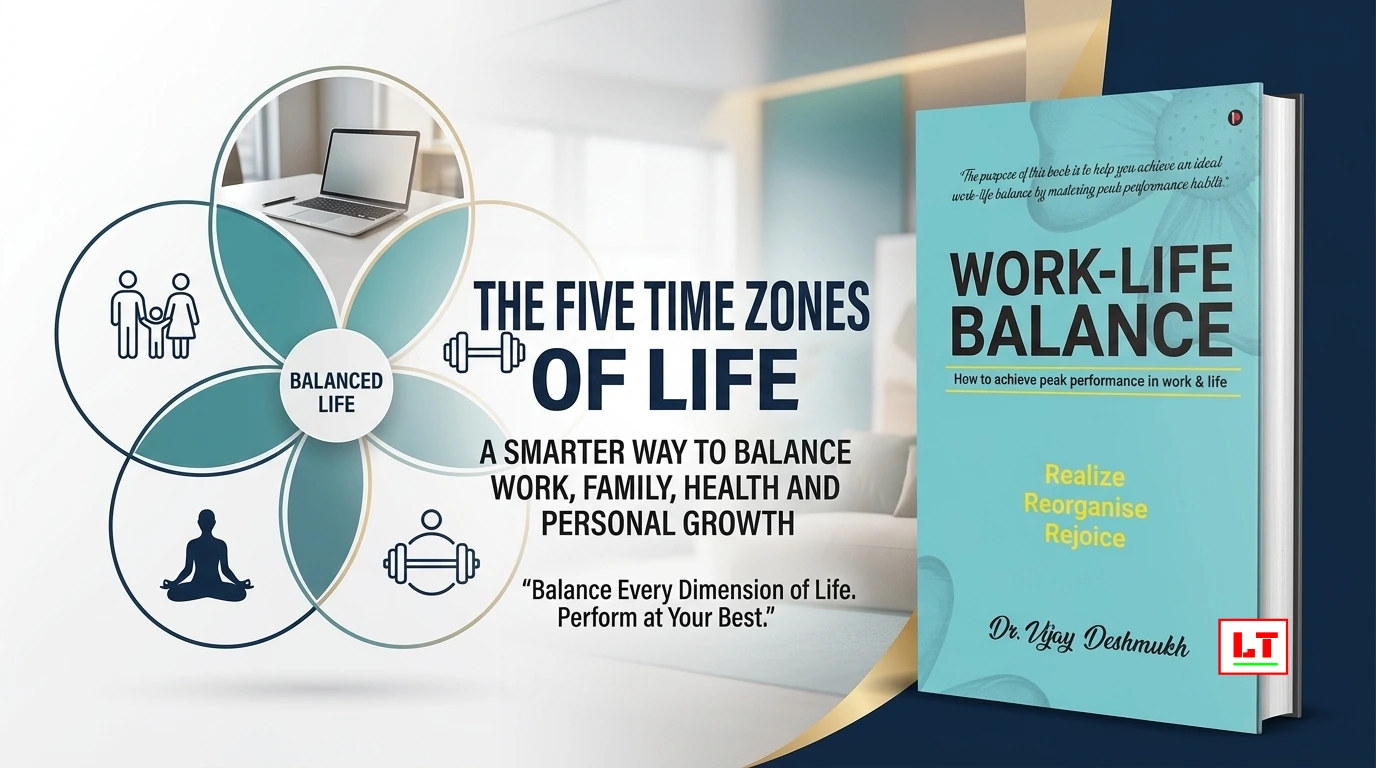
This is one of the important ideas explored in Work Life Balance: How to Achieve Peak Performance in Work and Life by Dr. Vijay Deshmukh. The book presents an interesting perspective: to achieve peak performance, individuals need to understand and intelligently manage the different “time zones” or dimensions of their lives.
What Are the Different Time Zones of Life?
Life is not one single activity. It is made up of several interconnected areas. Dr. Deshmukh’s “Flower of Life” philosophy highlights different dimensions, including:
- Professional Life
- Family Life
- Personal Life
- Social Life
- Spiritual Life
Each area requires attention. The challenge is not necessarily to give every area exactly the same amount of time. The real challenge is to ensure that one area does not permanently consume all the others.
1. Professional Life
For many adults, professional life occupies a significant portion of the day. Career growth provides financial security, identity, achievement, learning, and purpose. There is nothing wrong with ambition. The problem begins when professional responsibilities become so dominant that everything else is pushed aside.
A healthy professional life requires:
- Clear priorities
- Focused work
- Effective delegation
- Proper planning
- Appropriate breaks
- Defined boundaries
Peak performance does not mean being available every minute. It means using your energy intelligently to produce meaningful results.
2. Family Life
Professional achievement becomes less meaningful when relationships are continuously neglected. Family requires presence, not merely physical proximity. Being at home while constantly checking emails is not the same as spending quality time with family. Small actions matter:
- Eating together
- Listening without distractions
- Discussing important issues
- Celebrating milestones
- Supporting one another
A few minutes of genuine attention can sometimes be more valuable than several hours of distracted presence.
3. Personal Life
Personal life includes the relationship you have with yourself. This area is often neglected because people assume that personal time is optional. It is not.
Reading, exercise, hobbies, quiet reflection, learning, and rest help recharge the mind and body. Without personal renewal, professional performance eventually suffers. A tired mind may continue working, but it does not necessarily work intelligently.
4. Social Life
Human beings need meaningful social connections. Friends, colleagues, mentors, and communities provide emotional support, new perspectives, encouragement, and a sense of belonging. Professionals who completely isolate themselves in pursuit of career goals may eventually experience emotional fatigue.
Social connection does not mean attending every event. It means maintaining meaningful relationships. Quality matters more than quantity.
5. Spiritual Life
Spirituality can mean different things to different people. For some, it may involve meditation. For others, it may involve prayer, contemplation, self-reflection, nature, or understanding a deeper purpose. The important aspect is creating space to look beyond immediate tasks and ask larger questions.
Who am I?
What is truly important?
What kind of life am I creating?
What does success mean to me?
These questions can create clarity that ordinary productivity tools cannot provide.
Why One Time Zone Cannot Replace Another
Imagine a professional who spends nearly every waking hour working. Financially, the person may progress. But what happens if health deteriorates? What happens if relationships weaken? What happens if there is no time for personal reflection? The result may be professional success combined with personal dissatisfaction.
Similarly, someone who focuses entirely on leisure may enjoy the present but struggle to create financial security or professional growth. Balance does not mean choosing one area over another. It means managing the whole system.
Work-Life Balance Is Not About Equal Hours
This is an important distinction. Work-life balance does not mean spending exactly eight hours working, eight hours with family, and eight hours sleeping. Life does not operate with such mathematical precision. Some periods demand greater professional attention.
At other times, family responsibilities may require more time. During illness, health becomes the priority. During major career transitions, professional development may require additional effort. Balance is therefore dynamic. It means consciously adjusting attention according to the circumstances of life.
The Hidden Cost of Poor Balance
When one area continuously dominates life, the consequences can gradually appear. Poor balance can contribute to:
- Chronic stress
- Emotional exhaustion
- Reduced concentration
- Relationship problems
- Declining health
- Lower productivity
- Loss of motivation
The danger is that these consequences often develop slowly. By the time a person recognizes the problem, the imbalance may already have become a lifestyle.
How to Manage Your Time Zones Intelligently
A practical approach is to review each life dimension every week. Ask yourself:
Professional: Am I focusing on meaningful priorities?
Family: Am I giving enough quality attention to people who matter?
Personal: Am I taking care of my physical and mental energy?
Social: Am I maintaining meaningful connections?
Spiritual: Am I creating time for reflection and inner clarity?
The objective is not perfection. It is awareness. Once you can see the imbalance, you can begin correcting it.
The Role of Technology
Technology has dramatically improved productivity. But it has also blurred boundaries. A professional may receive work messages at dinner, answer emails before sleeping, and check notifications immediately after waking. Technology should be a tool—not a permanent source of interruption. Simple boundaries can help:
- Disable unnecessary notifications.
- Establish email-free periods.
- Avoid checking work messages during family meals.
- Create a defined end to the working day.
- Use technology intentionally.
The goal is not to reject technology. It is to control how technology interacts with your life.
Peak Performance Requires Recovery
One of the most important lessons for high performers is that recovery is part of performance. Athletes understand this. They do not train continuously without rest. The human mind and body also need recovery.
Sleep, relaxation, family interaction, exercise, hobbies, and quiet time are not obstacles to productivity. They support productivity. A rejuvenated person can often achieve more in a focused hour than an exhausted person can achieve in several distracted hours.
Why Work Life Balance Is Relevant
Dr. Vijay Deshmukh’s book approaches work-life balance as a practical philosophy rather than simply a productivity technique. The story of Rajan and Tina reflects the challenges faced by many ambitious professionals.
Their journey illustrates how uncontrolled competition, stress, and misunderstanding of life’s priorities can affect health and relationships. The book then introduces practical principles that help them rediscover balance and ultimately achieve greater success and happiness.
Recommended Book
Work Life Balance: How to Achieve Peak Performance in Work and Life
For professionals struggling to balance career ambitions with personal responsibilities, this book offers practical insights into stress management, time management, peak performance, and balanced living.
Conclusion
Peak performance does not come from giving everything to one area of life. It comes from understanding the complete picture. Professional life matters. Family matters. Personal health matters. Social relationships matter. Inner development matters. When these dimensions are managed consciously, success becomes more sustainable and life becomes more fulfilling. The real objective of work-life balance is therefore not simply to “find more time.”
It is to use the time we have more intelligently.
That may ultimately be one of the most important lessons for anyone seeking both professional excellence and a happy life.
FAQs
What are the five time zones of life?
The framework discussed in Work Life Balance includes professional, family, personal, social, and spiritual dimensions of life.
Does work-life balance mean dividing time equally?
No. Balance is dynamic. Different areas may require different amounts of attention at different stages of life.
How can professionals identify imbalance?
Regularly review your work, family, personal, social, and inner life and identify which areas are consistently being neglected.
How does work-life balance improve performance?
Balanced living supports mental recovery, emotional stability, healthier relationships, and better focus, which can contribute to sustainable professional performance.
Inspiring Authors.
Fresh Perspectives.
Discover remarkable books, inspiring author stories, exclusive literary insights and fresh ideas delivered directly to your inbox.
