
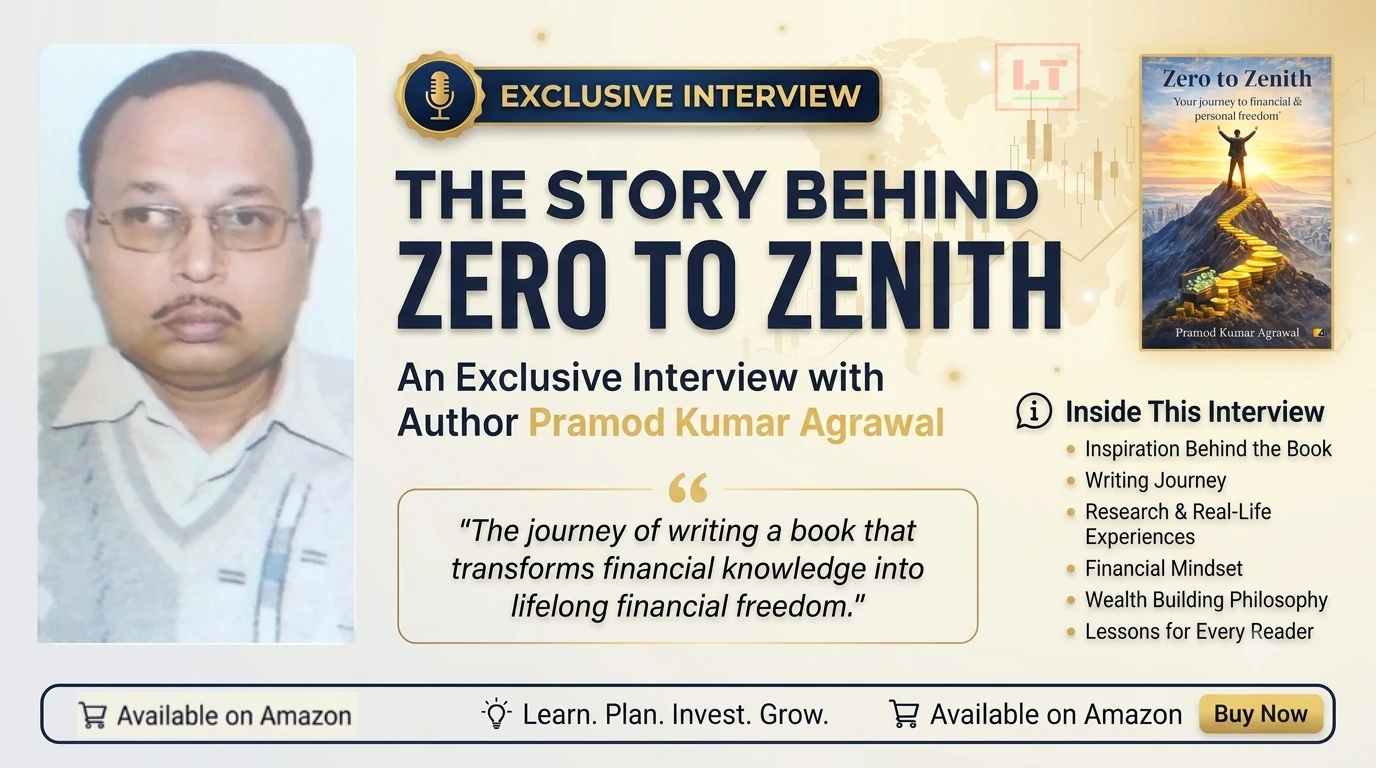
Personal finance has become one of the most discussed topics in India over the last decade. While investment opportunities have expanded rapidly, financial literacy has not grown at the same pace. Many individuals still struggle with budgeting, investing, retirement planning, emergency savings, and protecting their wealth from financial fraud.
Recognizing this challenge, Pramod Kumar Agrawal authored Zero To Zenith: Your Journey To Financial & Personal Freedom, a comprehensive guide that simplifies financial planning for Indian readers. Covering 17 systematically designed chapters, the book explains everything from financial mindset and assets versus liabilities to mutual funds, stock markets, passive income, tax planning, retirement strategies, and children’s education planning.
Unlike many finance books that rely heavily on technical language, Zero To Zenith explains every concept using practical examples, Indian financial situations, and easy-to-understand language. In this exclusive interview, Pramod Kumar Agrawal shares the story behind writing the book, the challenges he faced, and the message he hopes every reader will take home.
Q1. What inspired you to write Zero To Zenith?
Answer by Pramod Kumar Agrawal:
The idea came from years of observing how intelligent and hardworking people often struggled with money simply because they lacked financial education. Many people earn well but fail to build wealth due to poor planning. I wanted to create a guide that simplifies finance for ordinary readers. My objective was to provide practical financial education that anyone could understand and apply. I believe financial literacy should be accessible to everyone, not just finance professionals.
Q2. Why did you choose to write specifically for Indian readers?
Answer by Pramod Kumar Agrawal:
Indian families have unique financial priorities. We save for children’s education, support extended families, prepare for retirement differently, and often make financial decisions based on cultural values. Many international finance books don’t fully address these realities. I wanted every chapter to feel relatable to Indian readers by using Indian currency examples, familiar financial situations, and practical advice suitable for our economic environment.
Q3. How much research went into writing this book?
Answer by Pramod Kumar Agrawal:
A great deal of research was involved. I studied personal finance principles, Indian investment options, government regulations, taxation, and common financial behaviors. Beyond research, I also drew from practical observations and real-life financial situations. My goal was to balance technical accuracy with reader-friendly explanations. Every chapter was carefully structured so readers could progress naturally from basic financial concepts to more advanced investment strategies.
Q4. What was the biggest challenge while writing the manuscript?
Answer by Pramod Kumar Agrawal:
The greatest challenge was simplifying complex financial topics without losing their practical importance. Finance can quickly become confusing if presented with excessive technical terminology. I spent considerable time rewriting explanations to ensure they remained clear and useful. Another challenge was organizing the chapters so readers would gradually develop confidence instead of feeling overwhelmed. Simplicity was always my highest priority.
Q5. Why does the book begin with financial mindset instead of investing?
Answer by Pramod Kumar Agrawal:
Many people think investing alone creates wealth, but I strongly believe mindset comes first. Without discipline, patience, and financial awareness, even the best investment strategies can fail. A person’s habits determine long-term financial outcomes more than individual investments. Therefore, I wanted readers to first understand their relationship with money before discussing investment products. Strong financial habits build stronger financial futures.
Q6. Which chapter is closest to your heart?
Answer by Pramod Kumar Agrawal:
The chapter discussing financial independence and long-term planning is particularly meaningful to me. It introduces readers to the philosophy behind wealth creation rather than simply teaching financial products. I believe true financial freedom means having peace of mind, security, and confidence in the future. This chapter sets the foundation for everything that follows in the book and reflects my overall philosophy toward personal finance.
Q7. How do practical examples improve learning?
Answer by Pramod Kumar Agrawal:
People learn better when they can relate concepts to everyday situations. That’s why I included Indian family examples, practical calculations, realistic scenarios, and simple illustrations throughout the book. Readers shouldn’t feel like they’re studying a finance textbook. Instead, they should feel they’re learning practical life skills they can immediately apply. Practical examples make financial education engaging and memorable.
Q8. What do you hope readers feel after completing the book?
Answer by Pramod Kumar Agrawal:
I hope readers feel empowered rather than intimidated by finance. My goal is to replace confusion with confidence. Financial planning should never feel overwhelming. Once readers understand the basics, they realize that consistent saving, disciplined investing, and thoughtful planning are achievable for everyone. I want readers to finish the book believing they are fully capable of taking control of their financial future.
Q9. How important is financial literacy for young professionals?
Answer by Pramod Kumar Agrawal:
Young professionals have the greatest advantage because time allows investments to compound significantly. Developing good financial habits early can create remarkable long-term results. Unfortunately, many young earners delay investing or spend without planning. I encourage them to begin with budgeting, emergency savings, and systematic investing as early as possible. Small financial decisions today often produce life-changing results decades later.
Q10. What message would you like to share with aspiring authors?
Answer by Pramod Kumar Agrawal:
Write with the intention of creating value for readers rather than simply publishing a book. Understand your audience deeply and communicate in language they appreciate. Authenticity and clarity are more powerful than complexity. Be patient throughout the writing process and never stop improving your manuscript. Every book has the potential to change someone’s life if written with sincerity and purpose.
Buy the Book on Amazon
👉 Buy Zero To Zenith: Your Journey To Financial & Personal Freedom on Amazon
FAQs
What inspired Pramod Kumar Agrawal to write Zero To Zenith?
His desire to simplify financial literacy for Indian readers inspired the book.
Is Zero To Zenith suitable for beginners?
Yes, it explains finance using simple language and practical Indian examples.
What topics are covered in the book?
Budgeting, investing, mutual funds, retirement planning, tax planning, passive income, emergency funds, and financial discipline.
Who should read this book?
Students, professionals, entrepreneurs, homemakers, and anyone seeking financial freedom.
