
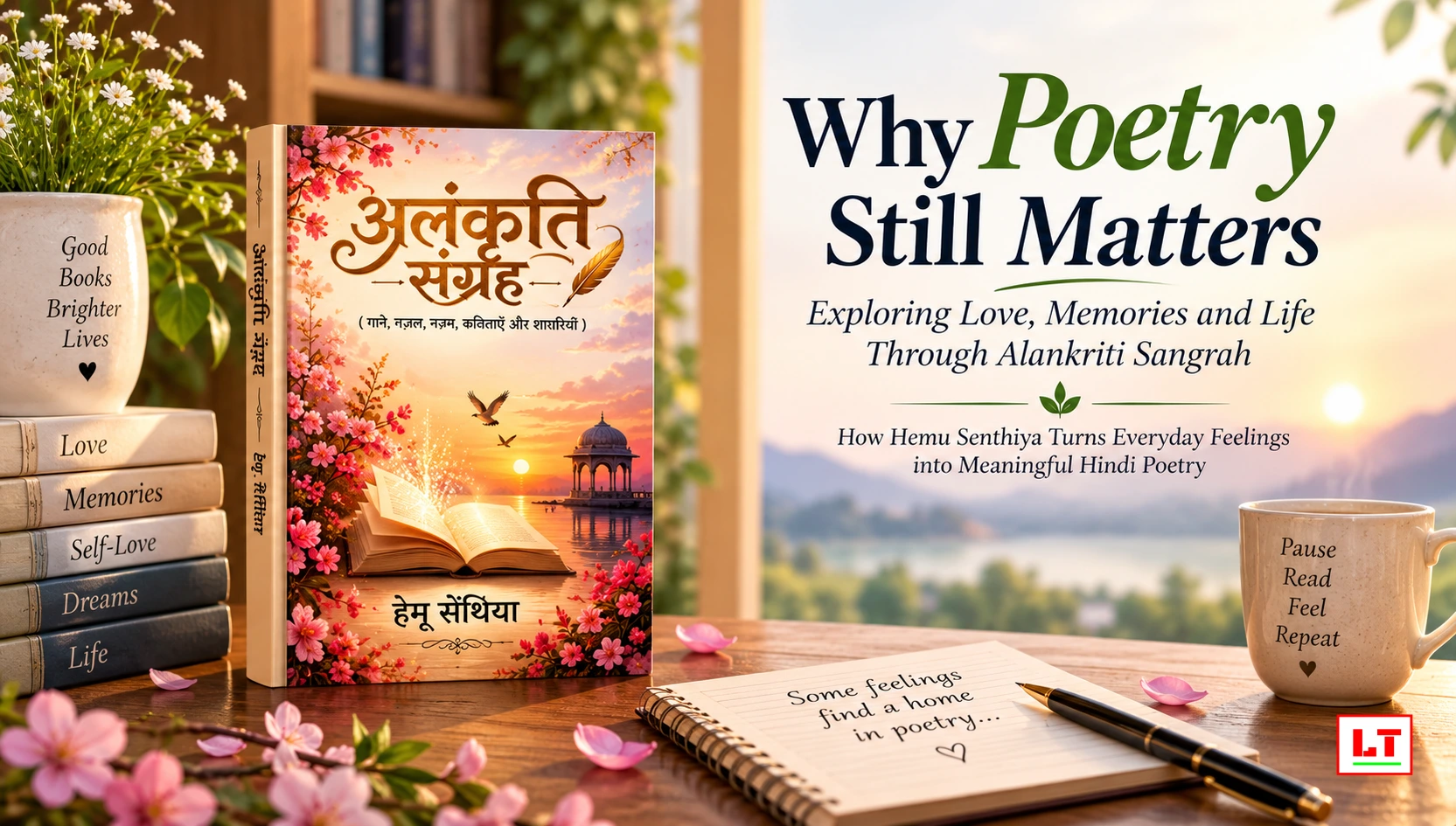
How Hemu Senthiya Turns Everyday Feelings, Relationships and Memories into Meaningful Hindi Poetry
In a world of quick messages, endless scrolling and constantly changing digital conversations, poetry asks us to do something increasingly rare: slow down and feel.
A poem may take only a minute to read, yet a single thought can stay with us for days. A familiar word can bring back a forgotten memory. A few lines about relationships can remind us of someone. A verse about dreams can make us look at our own aspirations differently.
This enduring connection between words and emotions lies at the heart of अलंकृति संग्रह (Alankriti Sangrah) by Hemu Senthiya (हेमू सेंथिया). Bringing together “गाने, ग़ज़ल, नज़म, कविताएँ और शायरियाँ”, the collection moves through love, relationships, memories, family, self-reflection, dreams, nature and social consciousness. Rather than presenting poetry as something distant from everyday life, Alankriti Sangrah explores feelings and experiences that many readers may already know—sometimes intimately.
Why Do We Still Turn to Poetry?
People have always searched for ways to express emotions that ordinary conversation cannot fully capture. We say that we miss someone, but those words may not describe everything contained within that feeling.
We say that a place reminds us of the past, but we may struggle to explain why its streets, fragrance or evening light still matter. We say that we have a dream, but sometimes the dream carries years of hope, disappointment and determination within it.
Poetry gives these emotions another language. It does not always need to explain a feeling logically. Sometimes it simply creates an image, captures a moment or places the right words beside an emotion. That is why poetry can remain relevant even as the way we communicate continues to change. Technology may change how quickly words reach us. Poetry can change how deeply they stay.
Alankriti Sangrah: Poetry Drawn from Everyday Emotions
Alankriti Sangrah brings different shades of human experience together rather than limiting itself to one emotional theme.
The collection includes pieces and themes such as Mitti Ki Khushboo (मिट्टी की खुशबू), Laado (लाडो), Yaadon Ka Shehar (यादों का शहर), Swayam Se Prem (स्वयं से प्रेम), Mehndi (मेंहदी), Chiraiya (चिरैया), Ek Tarfa Mulakaat (एक तरफा मुलाकात), Nagrik Bhavna (नागरिक भावना), Benaam Rishta (बेनाम रिश्ता), Sapno Ki Udaan (सपनों की उड़ान), Makhmali Chand Diary (मखमली चाँद डायरी) and Pyara Sa Swapn (प्यारा सा स्वप्न).
Even their titles reveal how widely the emotional landscape extends. There are relationships and memories.
There is family and affection. There is self-reflection. There are dreams. There are connections with familiar places and experiences. And there is also an awareness of life beyond the individual. Together, these themes make the collection less about one particular emotion and more about the many feelings that accompany different stages and moments of life.
Love Is More Than Romance
Love is one of poetry’s oldest subjects, but love itself has never been limited to romance. It can exist between parents and children, within friendships, in memories, in relationships that were never completely defined, and even in our relationship with ourselves. That broader emotional understanding is important when approaching Alankriti Sangrah.
A title such as Ek Tarfa Mulakaat immediately suggests the emotional weight a meeting can carry, even when the experience is not equally shared or does not develop into a conventional relationship. Benaam Rishta, meanwhile, evokes another familiar human experience: a relationship that matters even though it may be difficult to define. Not every meaningful relationship requires a label. Some people remain part of our lives through presence. Others remain through memory. And sometimes what remains unspoken becomes the very thing poetry is able to express.
When Memories Become a Place We Can Revisit
Memory has an unusual relationship with time. Years can pass, yet a fragrance, song, photograph or familiar street can suddenly make the past feel close again. That idea makes Yaadon Ka Shehar — “the city of memories” — particularly evocative. A city is made of buildings and roads, but the city we remember is often made of something else entirely.
It is made of people. Conversations. Journeys. Seasons. Goodbyes. Beginnings.
Moments we did not realise were important until they had already passed. In the same way, Mitti Ki Khushboo can evoke more than the fragrance of earth. It can suggest roots, home, familiarity and belonging. Poetry can take such ordinary sensory experiences and turn them into emotional doorways. The reader supplies the rest from their own memories.
The Importance of Swayam Se Prem
Among the themes represented in Alankriti Sangrah, Swayam Se Prem (स्वयं से प्रेम) brings attention inward. We often think about love in relation to another person. But what about the relationship we maintain with ourselves?
Self-love does not necessarily mean ignoring weaknesses or pretending that everything is perfect. It can mean understanding ourselves with greater patience, accepting imperfections and recognising that our own emotional well-being deserves attention too. This theme becomes especially relevant in a collection dealing with relationships and feelings. Before understanding every relationship around us, there are moments when we need to understand ourselves. Before seeking acceptance everywhere else, there may be value in learning self-acceptance. And sometimes poetry provides the quiet space in which that conversation can begin.
Family, Culture and the Beauty of Familiar Things
Not every meaningful subject needs to be extraordinary. Some of the strongest emotional connections in life are attached to remarkably familiar things. A daughter. Mehndi on someone’s hands. A bird outside a window. The fragrance of wet earth. A family celebration. A familiar voice. A place we once called home.
Themes such as Laado, Mehndi, Chiraiya and Mitti Ki Khushboo bring this world of familiarity into the collection. These subjects also carry recognisable Indian cultural and emotional associations. Laado can immediately suggest affection and tenderness. Mehndi may evoke celebrations, relationships, traditions and memories. Chiraiya can carry associations of freedom, tenderness, home and flight. The strength of such imagery lies in its simplicity. Readers do not always need an unfamiliar world to experience meaningful literature. Sometimes the most powerful writing helps them see their own world differently.
Poetry and the Power of Dreams
Poetry does not only preserve what has already happened. It can also imagine what has not happened yet. That makes dreams an important counterpoint to memory. Where memories connect us with yesterday, dreams invite us towards tomorrow. Themes such as Sapno Ki Udaan and Pyara Sa Swapn introduce aspiration, imagination and possibility into the emotional world of Alankriti Sangrah. Dreams can be deeply personal. For one person, a dream may mean achievement. For another, freedom. For someone else, it may simply mean a peaceful life, a meaningful relationship or an opportunity to begin again. The details may change, but the act of hoping remains remarkably universal. Poetry gives that hope a place to take flight.
Poetry Beyond Personal Feelings
One notable aspect of Alankriti Sangrah is that its thematic range extends beyond personal relationships and private emotions. Nagrik Bhavna (नागरिक भावना) introduces a broader perspective by turning attention towards civic consciousness and our relationship with society.
This matters because poetry has never belonged exclusively to romance. Writers have long used verse to reflect upon society, community, belonging, responsibility, nature and shared human experiences. Personal feelings tell us something about an individual. Social feelings remind us that the individual also exists within a larger world. Bringing these perspectives together adds another dimension to the collection.
Why Short Poetry Can Have a Long Life
A novel may require hours of continuous reading. A poem can sometimes create an emotional connection within minutes. That does not make poetry less substantial. It simply works differently. A poem can be read once and enjoyed. It can be read again and interpreted differently.
And it can be encountered years later, after the reader’s own life has changed, and suddenly carry an entirely new meaning. This is one reason poetry books often become books we return to rather than simply finish. You might open a collection today and connect with a poem about dreams. Months later, a poem about memories may feel more relevant. At another point in life, words about self-love or family may speak more strongly. The book remains the same. The reader changes. And therefore, sometimes, the poem changes too.
Who May Connect with Alankriti Sangrah?
Alankriti Sangrah may appeal to readers who enjoy Hindi literature that is rooted in emotions and familiar experiences. It may particularly interest readers who appreciate:
- Hindi poetry and shayari
- Ghazals and nazm
- Writing about love and relationships
- Poetry inspired by memories and nostalgia
- Family and culturally familiar themes
- Self-reflection and self-love
- Dreams, hope and aspiration
- Poetry connected with life and society
It can also suit readers who prefer a book they can experience gradually. A poetry collection does not always demand a beginning-to-end reading session. Sometimes you can simply open the book, discover a piece that matches your mood, read it, and return another day.
About Alankriti Sangrah
Book: Alankriti Sangrah (अलंकृति संग्रह)
Author: Hemu Senthiya (हेमू सेंथिया)
Language: Hindi
Category: Poetry & Shayari
Literary Forms: गाने, ग़ज़ल, नज़म, कविताएँ और शायरियाँ
Themes: Love, relationships, memories, family, self-reflection, dreams, nature and social consciousness
Rather than asking readers to remain within one emotional world, the collection moves across different experiences. That diversity allows individual readers to find their own points of connection. One reader may be drawn towards Yaadon Ka Shehar. Another may connect with Swayam Se Prem. Someone else may see part of their own story in Benaam Rishta or find encouragement in Sapno Ki Udaan. Poetry becomes personal in precisely this way.
About the Author – Hemu Senthiya
Hemu Senthiya is the author of Alankriti Sangrah, a collection that brings together multiple forms of Hindi creative expression. Through the themes represented in the book, her writing explores different dimensions of human emotion—from love, relationships and family to memories, dreams, introspection, nature and social consciousness.
The collection demonstrates an interest in experiences that are familiar but not always easy to articulate. Instead of separating the extraordinary from the ordinary, the poetry finds meaning in both. A memory can become a subject. A relationship can become a reflection. A dream can become an image. And an everyday emotion can become poetry.
A Book for Different Moods and Different Moments
There are books we read for information. There are books we read for entertainment. And then there are books we open because we want to feel something. Poetry often belongs to that third category. You may not approach every poem with the same emotion, and you may not connect with every piece in exactly the same way.
That is part of the experience. A poetry collection offers multiple doors. The reader chooses which one to open. With themes moving from love and memories to family, dreams, self-reflection and society, Alankriti Sangrah provides several such entry points.
Why Poetry Still Matters
Perhaps poetry continues to matter because human emotions have not become simpler. We may communicate faster, but we still experience longing. We may have thousands of photographs, but we still miss particular moments. We may remain constantly connected online, yet some feelings remain difficult to explain.
We continue to love. We remember. We dream. We lose. We hope. We change.
And whenever ordinary language feels insufficient, poetry offers another possibility. Alankriti Sangrah belongs to that continuing conversation between words and emotions. It reminds us that poetry does not always need to describe an unfamiliar world. Sometimes its greatest strength is helping us recognise our own.
Discover Alankriti Sangrah
If you enjoy Hindi poetry, ghazals, nazm and shayari that explore relationships, memories, dreams and different experiences of life, you can explore Alankriti Sangrah by Hemu Senthiya on Amazon.
Explore Alankriti Sangrah on Amazon
Frequently Asked Questions
What is Alankriti Sangrah?
Alankriti Sangrah is a Hindi literary collection by Hemu Senthiya featuring songs, ghazals, nazm, poems and shayari across different emotional and life-related themes.
What are the main themes of Alankriti Sangrah?
The collection includes themes related to love, relationships, memories, family, self-love, dreams, nature and civic consciousness.
Who wrote Alankriti Sangrah?
Hemu Senthiya (हेमू सेंथिया) is the author of Alankriti Sangrah.
Is Alankriti Sangrah only about romantic poetry?
No. Love and relationships are among its themes, but the collection also includes family, memories, self-reflection, dreams, nature and social consciousness.
What forms of writing are included in the book?
The book describes its literary forms as “गाने, ग़ज़ल, नज़म, कविताएँ और शायरियाँ.”
Who may enjoy Alankriti Sangrah?
Readers interested in Hindi poetry, shayari, ghazals, nazm and emotionally expressive writing about everyday life may find the collection appealing.
Where can I buy Alankriti Sangrah?
The book can be explored through its Amazon listing: Buy Alankriti Sangrah on Amazon
Inspiring Authors.
Fresh Perspectives.
Discover remarkable books, inspiring author stories, exclusive literary insights and fresh ideas delivered directly to your inbox.
