
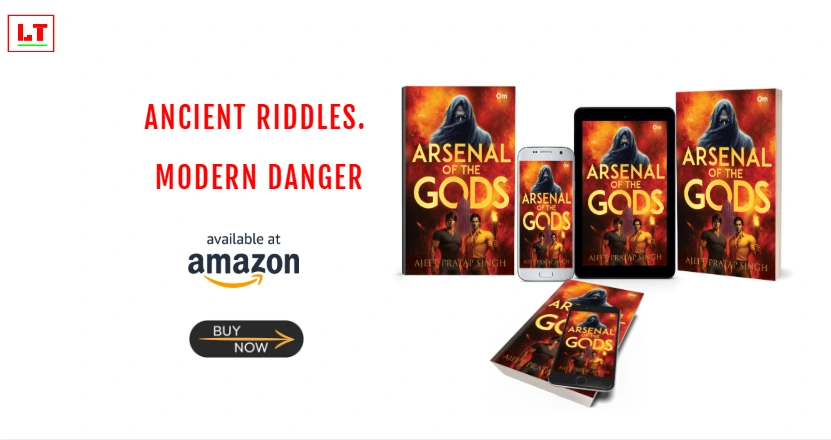
Arsenal of the Gods is a riveting mythological thriller that blends mystery, ancient Indian wisdom, and fast-paced adventure. The novel follows Rudra, who vanishes mysteriously for eleven days and wakes up thousands of kilometres away with no memory of what happened. Haunted by visions of temples, symbols, and forgotten stories, Rudra embarks on a journey across India—decoding Sanskrit riddles, uncovering hidden chambers, and confronting a secret society determined to locate a world-ending weapon from the Mahabharata.
Written by debut author Ajeet Pratap Singh, an engineer, chocolatier, and storyteller, the novel combines logical precision with imaginative depth. An alumnus of HBTU Kanpur with professional experience at Cadbury, Nestlé, and ITC, Ajeet draws deeply from his fascination with ancient Indian temples, architecture, and epic literature. Arsenal of the Gods explores identity, destiny, heritage, and the unsettling question of whether mythology is history—or prophecy.
Q1. What inspired the idea behind Arsenal of the Gods?
Answer by Ajeet Pratap Singh:
The inspiration came from a single question that refused to leave me—what happened to the divine weapons after the Mahabharata ended? The epics describe astras with unimaginable power, yet history falls silent about their fate. As I travelled to ancient temples and studied their symbolism, the idea grew into a story about forgotten knowledge, hidden guardians, and consequences humanity was never meant to face.
Q2. Your novel doesn’t retell the Mahabharata—it extends it. Why was this approach important?
Answer by Ajeet Pratap Singh:
The Mahabharata is timeless and sacred. Retelling it felt unnecessary. Instead, I wanted to explore the silence after the epic ended—the unanswered questions, the knowledge that may have survived in fragments. Arsenal of the Gods exists in that space, respecting the epic while daring to imagine what might have followed.
Q3. Rudra wakes up after eleven lost days with no memory. What does his journey represent?
Answer by Ajeet Pratap Singh:
Rudra’s journey is about identity. His lost memories symbolize forgotten history and suppressed truths. As he retraces his steps, he isn’t just solving riddles—he’s discovering who he truly is and confronting the idea that our lives may be shaped by forces far older than we realize.
Q4. Real temples and historical locations play a key role in the novel. How much research went into this?
Answer by Ajeet Pratap Singh:
Extensive research went into it. Every location in the book exists in reality, and many are places I’ve personally visited. Indian temples are architectural marvels filled with encoded symbolism. I wanted readers to feel that these spaces could genuinely hide secrets passed down through centuries.
Q5. Sanskrit riddles and ancient inscriptions form the backbone of the mystery. Why include this element?
Answer by Ajeet Pratap Singh:
Sanskrit is layered, symbolic, and deeply philosophical. The Mahabharata itself is full of hidden meanings. Using riddles and inscriptions allowed me to honour that tradition and engage readers intellectually, making them participants in the discovery rather than passive observers.
Q6. The Guruputras, a secret society in the novel, add intrigue and danger. What inspired them?
Answer by Ajeet Pratap Singh:
Throughout history, powerful knowledge has always been guarded by select groups. The Guruputras represent that idea—people who believe certain truths are too dangerous for the world. Their existence raises uncomfortable questions about who gets to decide what humanity deserves to know.
Q7. The weapon must be assembled before it can be destroyed. What does this paradox signify?
Answer by Ajeet Pratap Singh:
It reflects a deeper philosophical truth—understanding comes before destruction. You cannot eliminate something you don’t fully comprehend. This paradox mirrors humanity’s relationship with power, knowledge, and responsibility.
Q8. You are an engineer, chocolatier, and now an author. How did these diverse roles shape your writing?
Answer by Ajeet Pratap Singh:
Engineering gave me structure and logic, while my corporate experience taught me storytelling and discipline. Chocolate-making taught me patience and creativity. Writing this book was about balancing logic with imagination—precision with emotion.
Q9. The novel asks whether epics are memories or prophecies. Where do you stand on that question?
Answer by Ajeet Pratap Singh:
I believe epics are both. They are memories preserved as stories and warnings disguised as legends. How we interpret them depends on how deeply we’re willing to look beyond the surface.
Q10. What do you hope readers feel after finishing Arsenal of the Gods?
Answer by Ajeet Pratap Singh:
I hope readers feel a sense of wonder and curiosity—about mythology, heritage, and their own identity. More than anything, I hope the book encourages them to question what we accept as myth and consider what truths might still be hidden in plain sight.
