
A judgment may close a case, but it often opens a far larger conflict.
This article looks at how Jagnandan Tyagi’s fiction moves beyond courtroom drama to explore the wider consequences of justice and authority. Through The Mashal of Justice and Rise to Power, it reflects on how verdicts, ambition, and administrative decisions quietly reshape society, institutions, and personal integrity.
Crime and legal fiction often focus on investigation, suspense, and resolution. Jagnandan Tyagi’s books move in a different direction. Through The Mashal of Justice and Rise to Power, he explores what happens after decisions are made inside courtrooms and administrative chambers. His stories examine how verdicts and authority ripple outward, reshaping lives, institutions, and public trust.
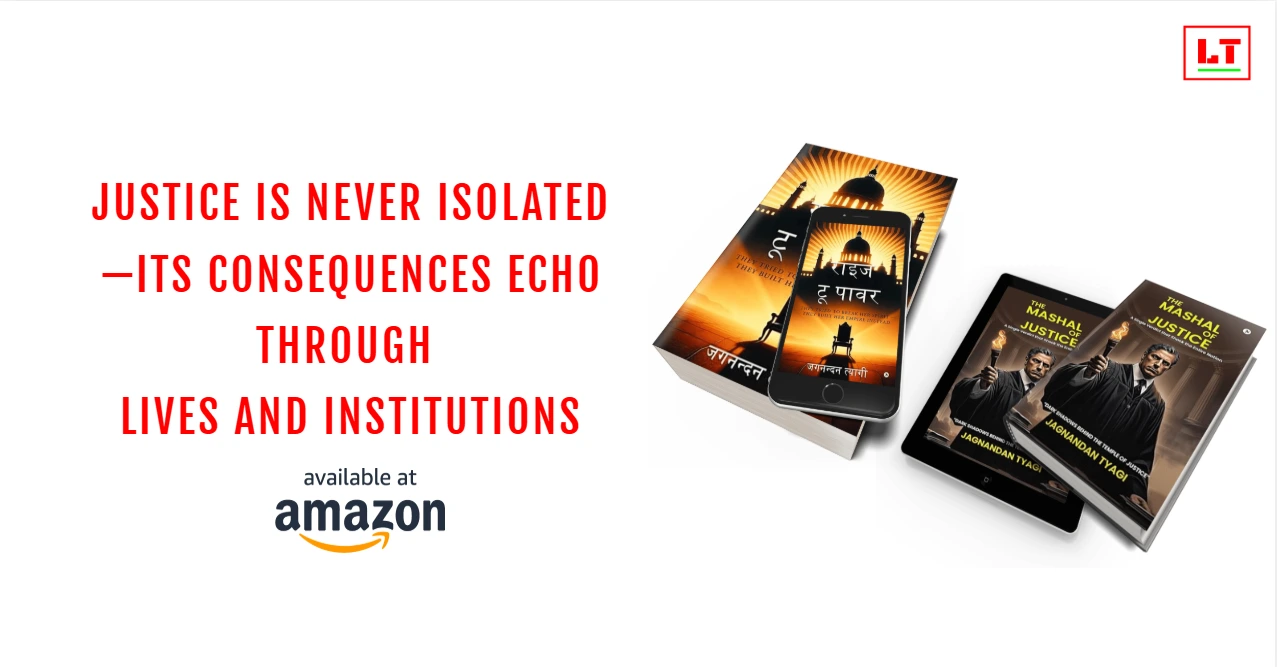
The Mashal of Justice: A Single Verdict that Shook the Entire Nation begins with a judicial decision but refuses to stop there. The novel treats the verdict not as an ending, but as a spark. Public reaction, administrative pressure, political influence, and ethical tension emerge as consequences of that single judgment. Through this approach, the story highlights how justice functions within interconnected systems rather than isolated legal events.
The narrative places strong emphasis on responsibility. Judges, officials, and administrators are portrayed as individuals operating under immense pressure. Their decisions carry legal authority, but also emotional and social weight. Rather than simplifying these roles, the novel presents them as complex positions shaped by expectation, accountability, and moral ambiguity.
The bilingual edition, THE MASHAL OF JUSTICE / द मशाल ऑफ़ जस्टिस, extends the reach of these themes. Language does not dilute the message; instead, it reinforces the universality of justice and consequence. The story resonates across audiences by addressing questions that remain relevant regardless of region or system: Who bears responsibility when a verdict changes everything, and how far does that responsibility extend?
While The Mashal of Justice focuses on the aftermath of judgment, Rise to Power / राइज टू पावर shifts attention toward the process of authority itself. The novel follows ambition as it navigates political and administrative structures. Power, in this narrative, is not portrayed as a reward but as a burden shaped by negotiation, compromise, and ethical testing.
In Rise to Power, authority evolves quietly. Decisions are not always dramatic, yet their effects are lasting. The novel examines how leadership gradually reshapes personal values and how governance requires choices that balance influence, responsibility, and consequence. Tyagi portrays power as something that demands constant ethical awareness rather than blind confidence.
What unites both books is their commitment to realism. Crime is never presented as an isolated act. Instead, it appears as a result of systemic pressure, institutional weakness, or human ambition. By focusing on administrative and legal realities, Tyagi transforms crime fiction into social reflection.
Another defining strength of these novels is restraint. There is no reliance on sensational twists or exaggerated villains. Tension is created through ethical conflict, procedural realism, and the knowledge that each decision carries weight. This approach allows readers to engage intellectually as well as emotionally.
Together, The Mashal of Justice and Rise to Power present justice and authority as evolving processes rather than fixed outcomes. Tyagi’s storytelling invites readers to question how systems operate behind visibility and how individual integrity is tested within them. His fiction reminds us that truth within governance is rarely simple and that power always demands accountability.
For readers who seek crime and legal fiction with substance, these books offer more than entertainment. They provide insight into the mechanics of justice, the fragility of trust, and the moral cost of authority.
Inspiring Authors.
Fresh Perspectives.
Discover remarkable books, inspiring author stories, exclusive literary insights and fresh ideas delivered directly to your inbox.
